Welcome to the Biker, Gothic, Baroque, Street Jewelry Blog, the first of its kind.


We scour the globe for the edgiest designers and artists for sterling silver jewelry - biker jewelry, gothic, baroque, skull rings, metal & leather works. The realist jewelry is often highly intricate; custom; handcrafted; imaginative; and beautifully created pieces of wearable art made in sterling silver and other precious metals. Established in 2008, Los Angeles. Instagram @excessive21.


𝓐𝓻𝓽𝓢𝓽𝔂𝓵𝓮𝓢𝓲𝓵𝓿𝓮𝓻.𝓝𝓮𝓽

Showing posts with label 頭蓋骨. Show all posts

Monday, December 4, 2023

Skulls, Time, Death & Eternity

 Skulls, Time, Death, and Eternity: Unveiling the Symbolic Tapestry


(Skullex Time Pendant - Excessive21 Collection)

In the vast mosaic of symbolism that human culture weaves, few motifs resonate as profoundly as skulls, time, death, and eternity. These elements, seemingly disparate, intertwine in a rich tapestry of meaning, offering insights into the enigmatic journey of existence.

The skull is a testament to mortality and transcendence. Central to numerous cultures across epochs, the skull encapsulates the duality of existence — serving as a potent symbol of mortality and the transitory nature of life. Universally recognized as a memento mori, it is a stark reminder of the inevitability of death, urging introspection on the fleetingness of our earthly sojourn.


Yet, the skull is not solely a harbinger of finality. It embodies a paradoxical essence, symbolizing not just the termination of life but also the gateway to eternity. In some belief systems, the skull represents the receptacle of the soul, a vessel transcending the bounds of corporeal existence.

Time, an intangible yet omnipresent force, weaves itself into the narrative of existence. Often depicted in symbolic artistry alongside skulls, it serves as a continuum, measuring the passage of life. The inexorable march of time, marked by the ticking of clocks or the turning of celestial bodies, underscores the finite nature of human experience.


In the juxtaposition of time and skulls, a poignant message emerges—the fleetingness of life. The ticking clock echoes the heartbeat, a reminder that every moment is precious, fleeting, and irreplaceable.

Death, shrouded in mystery and fear, stands as the ultimate equalizer; a threshold all must traverse. Cultures worldwide have imbued death with diverse symbolic interpretations. Some view it as an end, a cessation of existence, while others perceive it as a transition—a doorway to the unknown, beckoning towards a realm beyond mortal comprehension.


Skulls, time, death, and eternity - these symbols intertwine in a complex web of meaning, inviting contemplation on the enigmatic tapestry of human existence. While individually potent in their symbolism, their collective representation paints a mosaic that transcends cultural boundaries, speaking to the universal human experience.


They serve as reminders of the transient nature of life, the inexorable march of time, the inevitability of death, and the eternal essence that lies beyond. In embracing these symbols, we are invited not only to ponder the finite but also to glimpse the infinite, embracing the paradoxical beauty of our existence. They compel us to cherish every moment, honor the past, and ponder the eternal mysteries that lie ahead.


Thursday, March 10, 2022

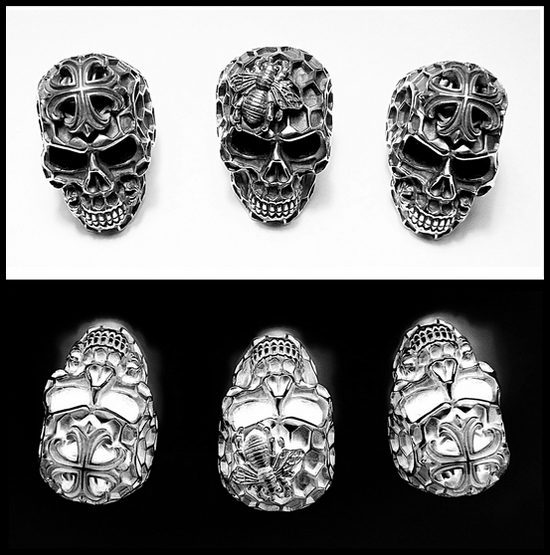
Honeycomb Skull Rings - B&W

As above, so below.


Throughout history, artists have been inspired by a variety of natural objects and phenomena, from the human form to landscapes and animals. Bees, honeycomb, and skulls are just a few examples of natural elements that have captured the imagination of artists across cultures and time periods. In this article, we will explore how these three objects have been used and expressed in art.

Bees and honeycomb are common motifs in art, especially in cultures that have a strong connection to nature. Bees symbolize fertility, abundance, and divine power. Also, the Bible references bees in several passages. Bees are mentioned as an example of hard-working creatures that gather food for their hives. In the book of Judges, Samson found a swarm of bees in the carcass of a lion he had killed, and he took honey from it to eat (Judges 14:8-9). In the book of Deuteronomy, the Promised Land is described as a land flowing with milk and honey, which has become a metaphor for abundance and prosperity (Deuteronomy 6:3). Additionally, in the book of Psalms, the sweetness of honey is used as a metaphor for the goodness of God's word (Psalms 19:10, 119:103). 

Honeycomb is often used as a visual metaphor for organization, unity, and efficiency. In Renaissance art, for example, honeycomb was often used as a decorative element in architectural motifs, symbolizing the harmony and order of the natural world. In contemporary art, honeycomb is often used as a material, with artists creating intricate sculptures and installations using beeswax and honeycomb. One of the most famous examples of honeycomb in art is the "Honeycomb" sculpture by Spanish artist Eduardo Chillida. Installed in 1991, this massive sculpture consists of several large honeycomb-like structures made of steel, which seem to float in mid-air. The sculpture is a stunning example of how natural forms can inspire art and architecture.

Skulls have a long history in art, with examples dating back to prehistoric times. In many cultures, skulls are associated with death and mortality, but they are also used as a symbol of rebirth and transformation. In Western art, skulls were often included in memento mori paintings, which were meant to remind viewers of the transience of life and the inevitability of death.

In contemporary art, skulls have been used in a variety of ways, from street art to high-end galleries. One of the most famous examples is the work of Mexican artist Frida Kahlo, who often included skulls in her self-portraits. In these works, Kahlo used the skull as a symbol of both her own mortality and her connection to Mexico's rich cultural heritage. Another example is the work of British artist Damien Hirst, who is known for his use of animal remains in his art. In his famous sculpture "For the Love of God," Hirst created a diamond-encrusted human skull that sold for over $100 million. The sculpture is a provocative statement on the relationship between art, death, and money.

Bees, honeycomb, and skulls are just a few examples of the many natural elements that have inspired artists throughout history. From ancient Egyptian regalia to contemporary sculpture, these objects have been used in a variety of ways to express ideas about life, death, and the natural world. Whether used as symbols or as actual materials, bees, honeycomb, and skulls continue to capture the imagination of artists and viewers alike.